
 Call us now:


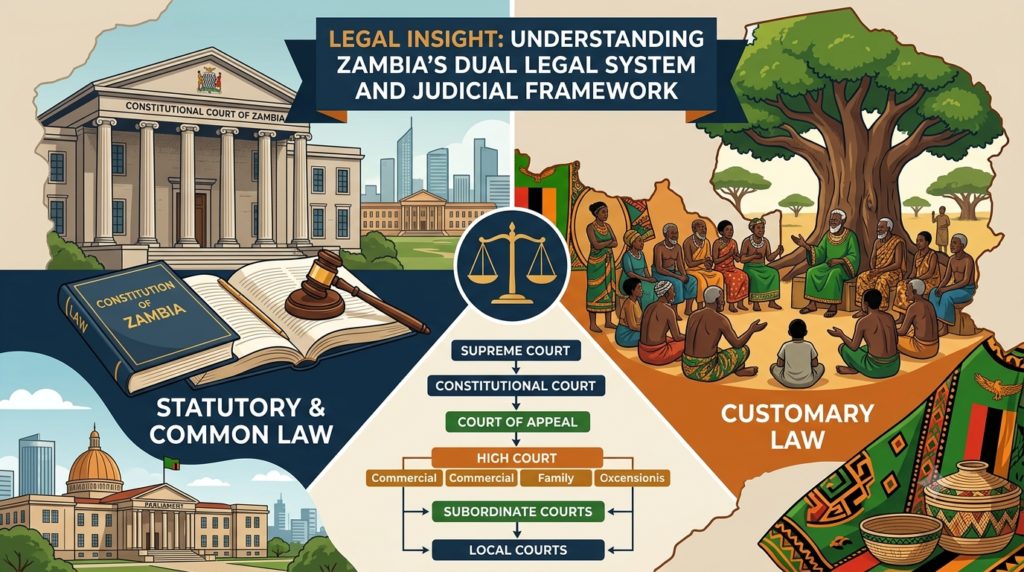
Table of Contents
Introduction
Understanding how Zambia’s legal system works is important for individuals, businesses, investors, and anyone interacting with government institutions. Zambia’s legal framework is based on a combination of statutory law, inherited English legal principles, and customary law that reflects the country’s diverse cultural traditions.
This combination creates what is known as a dual legal system, where formal written laws operate alongside customary rules recognised by the Constitution.
Zambia’s Dual Legal System
Zambia’s legal system consists mainly of:
- Statutory law — laws enacted by Parliament, including Acts of Parliament and statutory instruments.
- Received English law — including principles of English common law and equity that continue to influence areas where Zambian law is silent.
- Customary law — traditional laws and practices recognised within communities.
Where there is a conflict between customary law and written law, statutory law takes precedence. Customary law must also be consistent with the Constitution and must not conflict with principles of justice, morality, and public policy.
Customary law is commonly applied in areas such as marriage, inheritance, family disputes, and traditional community matters, particularly through Local Courts.
The Constitution: Zambia’s Supreme Law
The Constitution of Zambia is the highest law of the land. All other laws and government actions must comply with its provisions.
The Constitution establishes Zambia as a:
- Unitary state;
- Multi-party democratic republic;
- Constitutional democracy based on principles of good governance, accountability, transparency, and respect for fundamental rights.
It also establishes the separation of powers between the three branches of government:
The Executive
Responsible for implementing laws and running government administration.
The Legislature
Responsible for making laws through Parliament.
The Judiciary
Responsible for interpreting laws and resolving disputes independently.
Sources of Law in Zambia
The main sources of Zambian law include:
- The Constitution of Zambia.
- Acts of Parliament.
- Statutory instruments issued under legislative authority.
- Customary law consistent with the Constitution.
- Applicable English common law principles where Zambian law does not provide an answer.
Structure of the Zambian Courts
Zambia has an independent judiciary, with judicial authority derived from the people and exercised through the courts.
The court hierarchy includes:
Supreme Court
The Supreme Court is the highest appellate court for most matters. It hears appeals and cases involving important legal questions.
Constitutional Court
The Constitutional Court deals with matters relating to constitutional interpretation, enforcement of constitutional rights, and constitutional disputes.
Court of Appeal
The Court of Appeal hears appeals from the High Court and specialised courts.
High Court
The High Court has broad jurisdiction and includes specialised divisions such as:
- Commercial Division;
- Family and Children’s Division;
- Industrial Relations Division;
- Economic and Financial Crimes Division.
Lower Courts
These include:
- Subordinate Courts;
- Local Courts, which mainly apply customary law;
- Small Claims Court, which handles certain low-value monetary disputes.
Zambia’s Adversarial Legal System
Zambia follows an adversarial legal system, where parties present their cases before an impartial judge who determines the outcome based on the law and evidence presented.
Alongside court proceedings, Alternative Dispute Resolution (ADR) mechanisms are becoming increasingly important.
These include:
- Arbitration;
- Mediation;
- Negotiation.
Arbitration is particularly important in commercial disputes and is governed by the Arbitration Act, which incorporates international arbitration principles.
The Legal Framework for Business and Investment
Zambia’s legal system provides the foundation for business operations and investment.
Important commercial laws include:
- Companies Act, 2017;
- Insolvency Act, 2017;
- Employment Code Act, 2019;
- Investment, Trade and Business Development Act, 2022.
Foreign investors can generally own 100% of businesses in many sectors, subject to specific legal requirements, restrictions, and investment incentives.
Businesses must also comply with other areas of regulation, including:
- Tax laws;
- Employment regulations;
- Data protection requirements;
- Environmental regulations;
- Sector-specific licensing requirements.
Recent Legal Developments
Zambia’s legal landscape continues to evolve through legislative reforms and judicial decisions.
Recent developments have included changes relating to:
- Electoral laws;
- Local government legislation;
- Criminal law reforms;
- Public officials’ benefits;
- Cybersecurity and data protection.
The courts continue to play an important role in interpreting legislation and addressing constitutional questions affecting governance and public administration.
Practical Importance of Understanding the Legal System
For businesses, investors, and individuals, understanding Zambia’s legal framework helps in making informed decisions.
Before entering into contracts, purchasing property, starting a business, or resolving disputes, it is important to understand the applicable legal rules and seek appropriate guidance.
Legal practitioners and investors should regularly verify current legislation, as laws change and customary practices may differ between communities.
Resources such as ZambiaLII provide free access to many Zambian legal materials, while professional legal advice remains important for matters requiring specific interpretation.
Conclusion
Zambia’s legal system combines constitutional democracy, statutory law, English legal principles, and customary law. This pluralistic framework reflects the country’s history and diversity while providing a structured system for resolving disputes and protecting rights.
Understanding how the system works empowers individuals and businesses to make better decisions and engage more effectively with the law.